

The problem is not the technology. It is that these four categories are frequently treated as interchangeable when they were built to answer fundamentally different questions. Buying a people analytics platform when you need workforce intelligence is like buying a thermometer when you need a diagnosis. The reading is accurate. It just does not tell you what to do next.
Each of these categories evolved at a different point in time, in response to a different problem, with a different buyer in mind. Understanding what each one was actually built to measure, and where it stops, is the clearest way to figure out what your organisation genuinely needs.
Here is an honest breakdown of all four.
Four Categories, Four Different Questions
HR Analytics
HR analytics is the practice of using data generated by HR processes to understand how well those processes are running. It draws from systems the HR function directly owns: HRIS, ATS, payroll, and training records.
The questions it was built to answer are operational:
- How long does it take to fill a role?
- What is the attrition rate by department?
- How many employees completed mandatory compliance training?
These are legitimate and important questions. But they are backward-looking by design. HR analytics tells you how your HR function performed. It was never built to tell you how your workforce is performing.
People Analytics
People analytics extended the scope of HR analytics by pulling in data from outside the HR function. Finance data, sales performance, customer outcomes, engagement scores. The goal was to connect workforce data to business outcomes rather than just measuring HR process efficiency.
It is broader and more predictive than HR analytics. A people analytics platform can model attrition risk, identify high performers, and flag pay equity gaps.
The limitation is in the data itself. People analytics still draws primarily from structured HR records and periodic inputs like surveys and performance reviews. It analyses what has already been captured. It does not read what is actually happening in the work.
Workforce Analytics
Workforce analytics is often used interchangeably with people analytics, and in many organisations the two overlap significantly. Where they differ is in scope. Workforce analytics typically extends further into operational territory, covering contingent workers, scheduling, labour cost, and capacity planning alongside the traditional HR metrics.
It is the right tool for organisations that need visibility into a complex, multi-type workforce. The questions it answers tend to be about efficiency and cost: do we have the right number of people in the right places, and what is it costing us? Strategic capability questions sit outside its natural scope.
Workforce Intelligence
Workforce intelligence is the most recent of all and the most distinct in terms of what it actually measures.
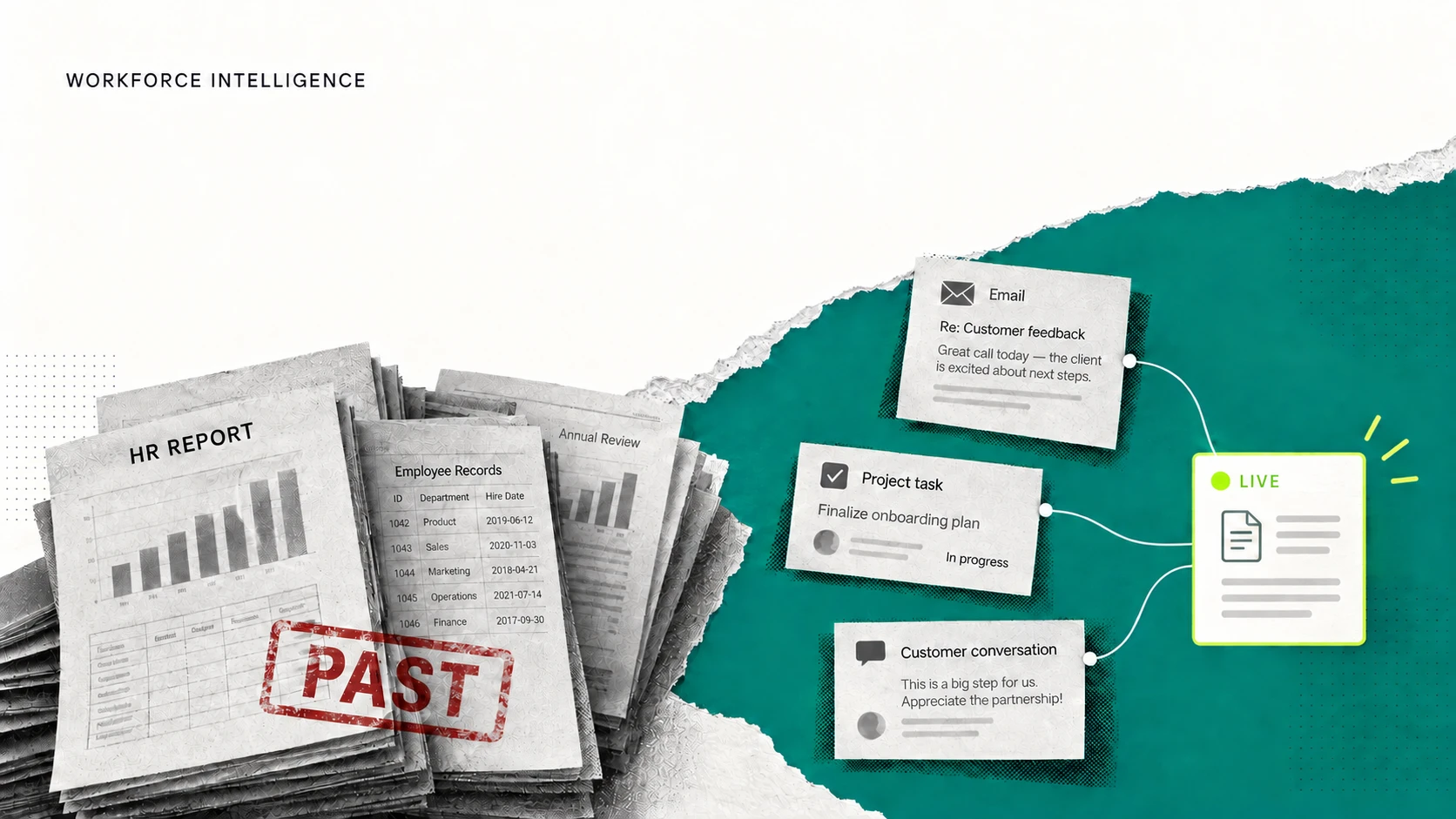
The other categories above; all work from data that has already been captured and stored such as a form someone filled in, a review someone submitted or a record someone updated. Workforce intelligence starts from a different premise. The most accurate signal of how someone is performing is not what they report about their work. It is the work itself.
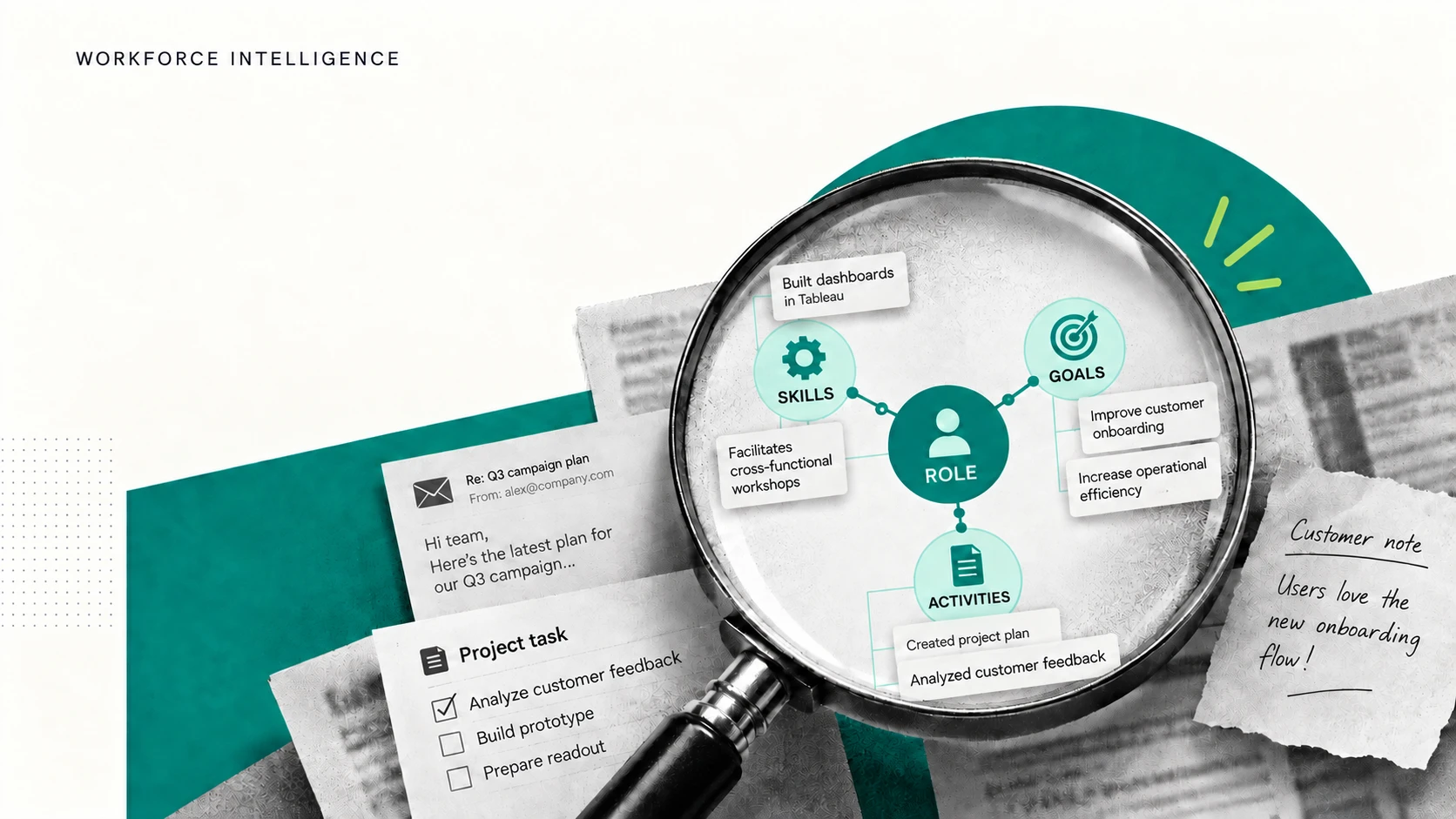
A workforce intelligence platform reads live signals from the tools your people already use, from communication and email to CRM and project management, and builds a continuous, role-level model of how people are actually performing and developing. Neither a snapshot from six months ago nor a score someone assigned in a review. What the work itself demonstrates, always explainable back to the evidence that produced it.
What workforce intelligence is and why it is different?
Every organisation is already producing an enormous amount of signal about how its people work. A sales rep's call patterns or a manager's one on one cadence.
- Whether a proposal was updated after a pricing conversation or left untouched?
- Whether a team's daily activities are aligned with the goals they committed to at the start of the quarter?
This signal exists inside the tools your people already use and it has never been connected into a coherent picture.
That is what separates workforce intelligence from other categories. It does not wait for data to be entered, reviewed, or reported. It reads what already exists.
There is another difference worth naming:
Other categories begin by measuring. Workforce intelligence begins by defining what excellence looks like for a specific role, at a specific level of seniority, inside a specific organisation, before measuring anyone against it.
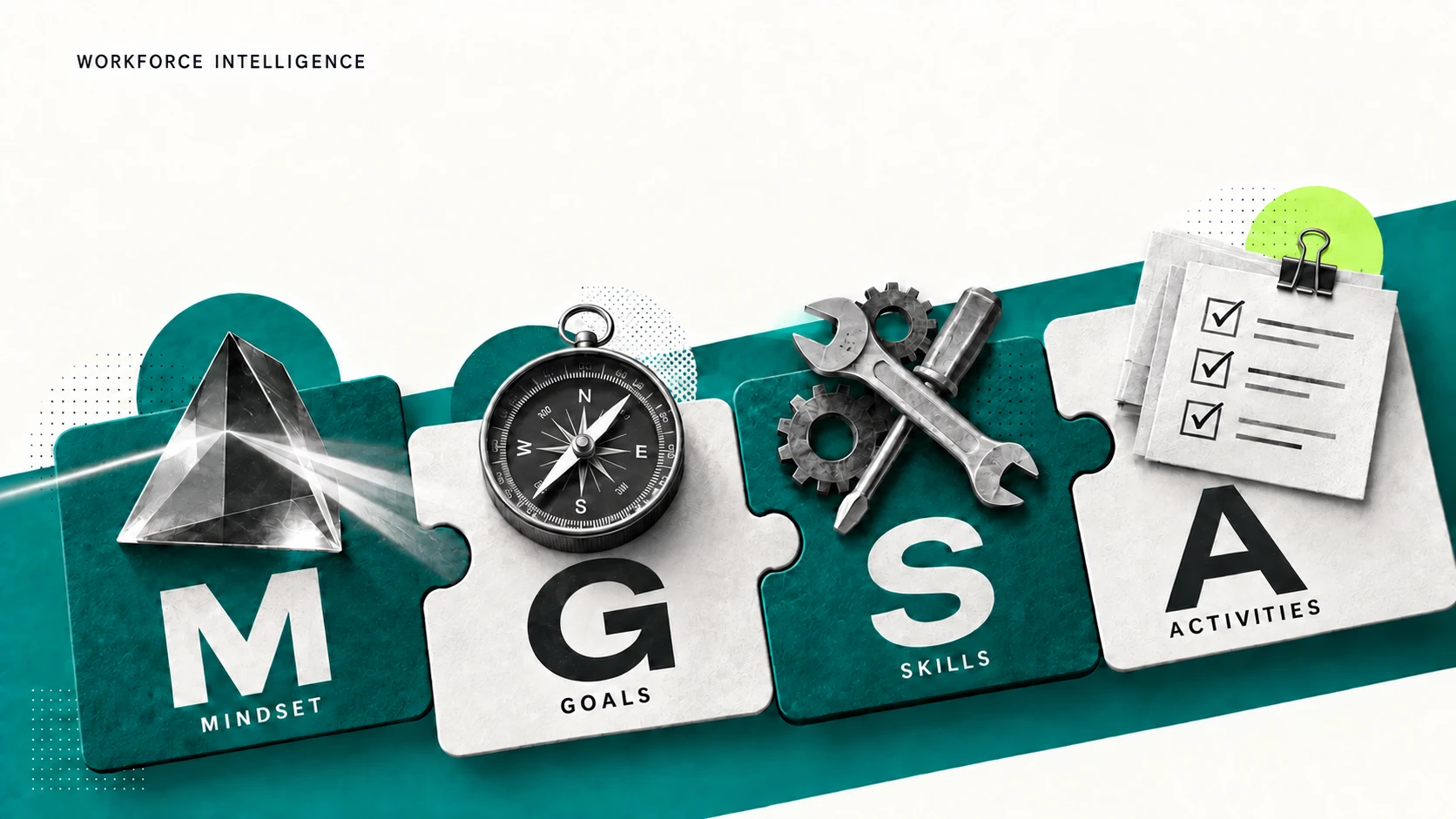
Lyearn's MGSA framework starts by asking a different question first: what does excellence actually look like for this role? Before any signal is read, it builds a specific, structured definition of what the right mindset, goals, skills, and daily activities look like for someone genuinely performing at their best in that position, at that level of seniority, inside that organisation. Every measurement that follows is read against that standard, not against a peer, not against a manager's impression.
The result is something none of the other categories produce. A continuous, auditable, role-level picture of how your workforce is actually performing, built from the work already being done, surfacing what needs attention before it becomes a problem.
How to know which one your organisation actually needs?
Most organisations do not have to choose between these categories. They already have one or two in place and are trying to figure out what is missing.
If your organisation has the operational and analytical foundations in place but leaders still cannot answer whether the workforce has the capability to execute what the business needs, that is the gap Lyearn was built to close.
See Lyearn in action. Request a demo.
Frequently asked questions

No. People analytics analyses structured HR data to surface patterns and inform decisions. Workforce intelligence reads live signals from the work itself and builds a continuous, role-level model of performance. One tells you what happened. The other tells you what is happening now.
HR analytics measures the efficiency of HR processes using data from HR-owned systems. Workforce analytics extends that scope to include labour cost, capacity planning, and contingent workers. Both are backward-looking. Neither measures whether people are actually performing in their roles.
They are not on the same spectrum. People analytics connects HR data to business outcomes. Workforce intelligence reads a different kind of data entirely, from the work itself, and answers a question the others cannot: whether your people are performing at the role level, right now.
Yes, if you need more than operational records. An HRIS stores and manages employee data. A workforce intelligence platform reads signals from how work actually happens and turns them into continuous, actionable insight. The two serve different purposes.
No. It connects across your existing tools and reads the signals they produce. It makes what those tools collect more useful by surfacing what none of them can show individually.
Mid to large enterprises where leaders need to know whether their workforce can execute business strategy. Industries with complex performance requirements, high development investment, or fast-changing skill needs see the most immediate value.